Knowledge & memory
Two different kinds of recall. Knowledge is a curated corpus an agent retrieves from with citations. Memory is a small set of durable facts about a person or an agent, carried between conversations. They are governed differently because they carry different risk.
| Knowledge | Memory | |
|---|---|---|
| Holds | Documents — handbooks, policies, specs, tickets | Facts — "prefers metric units", "owns the billing service" |
| Written by | Upload or a synced source | The agent, mid-conversation |
| Read via | search_knowledge, with citations | recall, plus automatic injection |
| Scoped to | A ring — personal, team, or org | A user, an agent, or both |
| Enabled by | knowledge: in the agent | memory: in the agent |
Knowledge collections
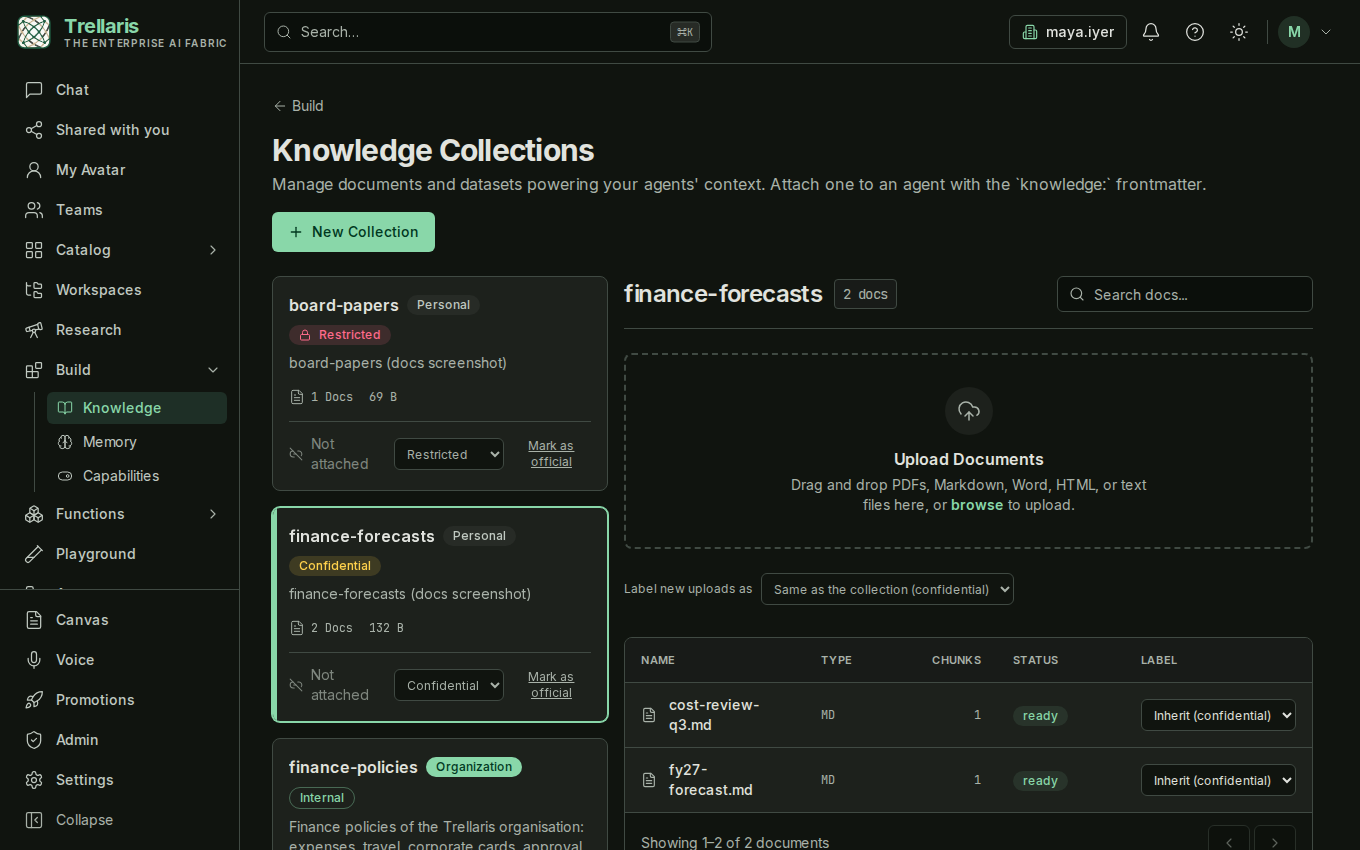
A collection is a ring-scoped bundle of documents. Attach one to an agent and
search_knowledge switches on, along with the citation contract in
the system prompt.
---
name: policy-answerer
model: default
knowledge:
  - hr-handbook
  - security-policies
---
Getting documents in
Upload
Drop files into a collection. PDF, DOCX, Markdown, HTML, and plain text are extracted natively.
Sync a source
Connect Confluence, Google Drive, SharePoint, Notion and more, and the collection keeps itself current on a schedule. New Gmail and Google Calendar sync as personal sources — private to you — to feed your avatar's knowledge graph.
Attach in chat
Drag a document onto a conversation to give one run its context, without adding it to a collection.
Ingestion
-
Store
The file lands in object storage, and the document row records its content hash. -
Extract
Text is pulled out per format. Ingestion is idempotent on the content hash, so re-uploading the same bytes does no work twice. -
Chunk
The text is split into overlapping passages of roughly 800 tokens, so a retrieved chunk carries enough context to stand on its own. -
Embed
Each chunk is embedded and indexed for vector search. The collection shows its status while this runs.
Retrieval and citations
search_knowledge returns chunks tagged with citation ids, and the
agent is instructed to cite them. Two properties matter:
- Citations are real. Every id in an answer corresponds to a chunk that exists and was actually retrieved.
- Absence is explicit. When nothing matches, the tool returns a clear "not in knowledge" result rather than an empty list — so the agent says it doesn't know instead of filling the gap from the model's own weights.
Classification labels New
Every collection and every document carries one of four labels: Public Internal Confidential Restricted. The collection's label is the default for its documents; a document may be given a higher one of its own. Anyone who may write the collection may raise a label, only an organisation admin may lower one, and the default for everything is Internal. A run that reads a labelled chunk carries the label from then on, and the organisation's data perimeter decides what it may do with the web, a browser or another agent afterwards. Synced Google Drive and Microsoft 365 sensitivity labels arrive through a map the admin keeps. The whole mechanism is on Data classification.
Synced sources and permissions
A synced collection stays current on a schedule, and the sync is careful in three ways that matter operationally:
| Behaviour | Why it matters |
|---|---|
| Delta detection | Unchanged documents are not re-embedded. A large space re-syncs cheaply. |
| Permission-only changes are cheap | If only access changed, chunks are restamped without re-embedding. |
| Deletes tombstone | A document removed at the source is marked removed and its chunks are deleted, so it stops being retrievable. |
Memory
Memory is deliberately small. The agent decides what is worth keeping via
remember, retrieves with recall, and the most relevant
memories are injected into later turns automatically — so the user doesn't have
to repeat themselves and the agent doesn't have to search every turn.
memory: | Scope |
|---|---|
user | Facts about the person, shared across their agents. |
agent | Facts this agent learned, not visible to other agents. |
user+agent | Both. |
| omitted | No memory tools at all. |
Writes are deduplicated: a fact restated in different words or a different order updates the existing entry in place rather than accumulating near-duplicates.
Memory is personal data and is treated as such. It is user-scoped by construction — one person's memories are never visible to another, and administrators do not read them at the default privacy tier. Users manage their own under Settings → Memory, including deletion.
Choosing between them
| If the information… | Use |
|---|---|
| Lives in documents someone else maintains | A synced knowledge source |
| Is a fixed corpus you control | An uploaded knowledge collection |
| Matters only to this one question | A chat attachment |
| Is a durable fact about the person | Memory, scope user |
| Is something the agent learned about its own job | Memory, scope agent |
| Is a procedure to follow | A skill, not knowledge |